This is a beginner's guide to hiking Mt. Fuji. I just got back back from taking my 16 and 19 year old sons to hike Mt. Fuji, and despite our best preparations, things did not quite go as planned. My intention for making this web site is to make this wonderful adventure much easier for all future travelers. Here is my most important advice to make a MUCH more comfortable and fun trip (scroll down rest of page for more details, photos, and other personal insight into this incredibly scenic and fascinating mountain).
- First, I know everyone tries to hike up Mt. Fuji in middle of night in order to see sun come up first thing in morning. While the sunrise is no doubt incredible, you will be missing the entire beauty of the hike of Mt. Fuji, not to mention this is quite a steep and treacherous boulder hopping hike in the daytime, let alone in the middle of the night. If you go at night, buy a Petzl (https://www.petzl.com/US/en/Sport/PERFORMANCE-headlamps/REACTIK-PLUS#.WFBMceYrKM8) or other really nice 200 or more lumen headlamp (with back up batteries or pack). My advice is consider hiking up in the day time and enjoy the gorgeous Mt. Fuji scenery. And no, you will not see the same scenery on the hike down, since it is different ... hiking down is done via a very steep shale (very loose gravel) "road" instead of the scenic trail up.
- Have decent amount of Yen (Japanese money) in your pocket (or even better, stashed secretly in travel fanny pack inside of your pants, or other hidden location) ... everything in Japan occurs best with cash (trains, taxis, Fuji huts, restaurants, using restrooms on hike up Mt. Fuji, and most other services in Japan) ... AVOID plastic credit cards (but take them in case of emergency). Cost of hut on Mt. Fuji, for example, is about 6,000-8,000 Yen per night (more if food included). 1,000 Yen is about $10 US dollars (depending on exchange rate). Also, remember, it is customary to pay voluntary 1,000 Yen per person to climb Mt. Fuji (payable staff at Station 5 ... they are extremely helpful also ... they made last minute Sato-Goya Hut reservation for me)
- Boy Scout Motto: BE PREPARED ... weather can change in a few minutes on Mt. Fuji. It might be tempting to pack light, but make sure you bring LAYERS of clothes (gets really hot, then minutes later really cold), wear hiking boots (and do some training hikes to break them in before you arrive); bring waterproof (e.g., Gore-Tex) pants, jacket (light shell best), and gloves; consider wearing gaiters; bring beanie hat (much warmer than baseball hat) and also baseball cap; good sunglasses (with UV protection); bring plenty of food (high energy, e.g., power bars) and water or sports drinks like Gatorade (2-3 liters minimum, 4 liters best) (full packing list below); also bring trash bags with you to pack out waste (there are no trash cans anywhere on Mt. Fuji and almost none in all of Japan we saw) -- they can also be used as pretty good rain ponchos. Hiking stick, or even better, actual hiking poles are very useful, especially when you get farther up mountain to more rocky terrain. And don't forget lights if you are hiking at night ... headlamps best (best ones, in my opinion, since I run Ultra Marathons at night, are Petzl headlamps, minimum 100 lumens, best is 200 lumens (literally turns night into day) ... bring extra triple A batteries ... here is Petzl link (https://www.petzl.com), but you can get them online at Amazon, REI, etc.
- Consider staying at Mt. Fuji Hut on the way up for few hours of sleep ... makes ascent and altitude accommodation MUCH easier (more info on this below)
- Bring cell phone for emergency (Mt. Fuji coolest "remote" place I have ever seen ... full cell and Internet service all the way up the mountain ... arrange this with your mobile carrier) ... Sprint has incredible $5 per month Japan only unlimited cell & Internet
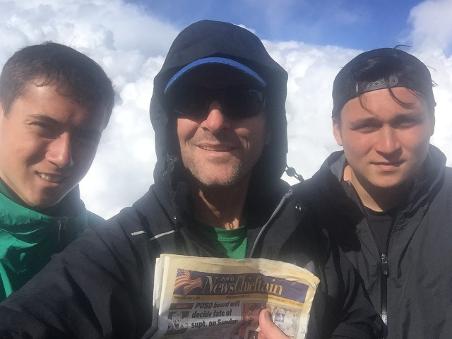
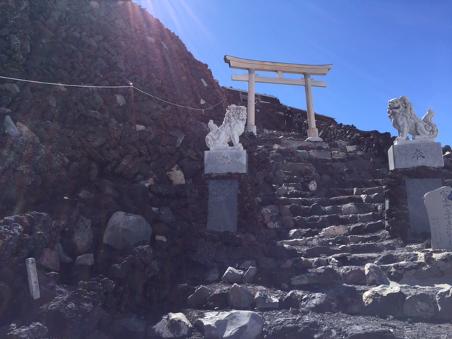
This is the top of Mt. Fuji (elevation 12,389 ft). Those are the last few steps through the archway leading to Mt. Fuji. Approximately 200,000-300,000 people hike to the top of Mt. Fuji each year -- takes about 6-7 hours to get to the top, and 3-4 hours to get down. We hiked the Yoshida Trail (one of 4 trails you can hike ... each trail has 10 stations, with 1 on the bottom and 10 on the top of Mt. Fuji ... you can hike in July and August ... we hiked in mid July, avoiding most of the weekend and busier August crowds ... more on this below). The most incredible thing about being on the top of Mt. Fuji was looking into the volcanic crater (which last erupted as recently as December 16, 1707) ... I did not get a photo there since winds were very high and we were literally standing in the middle of a cloud. I was also slightly nervous I would be the lucky person standing there at the exact moment it decided to erupt again (my concerns verified by later looking up the frequency of Mt. Fuji eruptions: 1707-08, 1700, 1627(?), 1560, 1511, 1427(?), 1083, 1032, 1017(?), 999(?), 993(?), 952(?), 937(?), 932, 870, 864-65, 830, 826, 802, 800, 781). You will be greeted by vending machines and a few small stores on the top (never sure how they get supplies all the way there ... I later found out that small tractors with tank treads roll up the mountain on the same small road you descend taking supplies up to huts). And I got to call my wife on my cell phone ... not everyday you can say, "Hi, honey, I am calling you from the top of Mt. Fuji." We decided to hike during the day as weather was really bad both nights we were there and we also really wanted to experience the wonderful scenery on the way up ... but we did get thunder, lightning, and heavy rain on the way down.
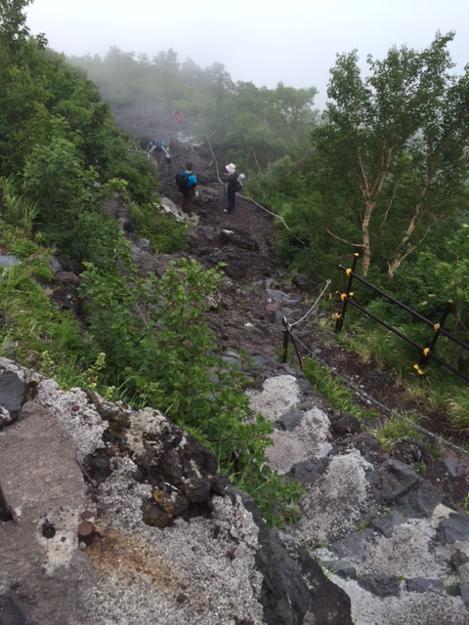
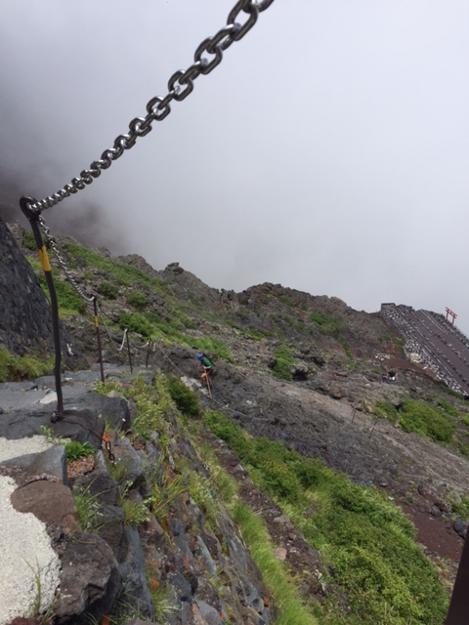
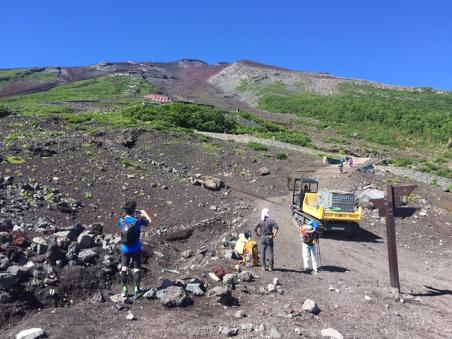
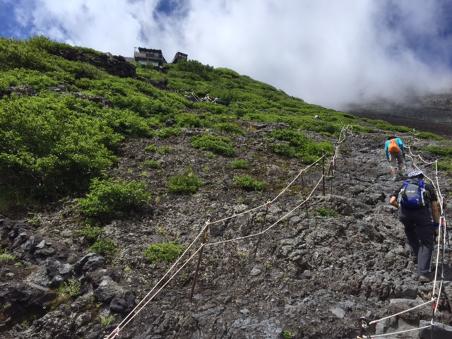
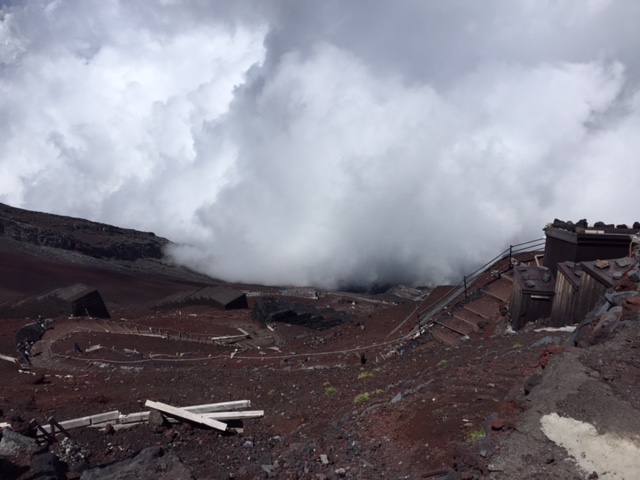
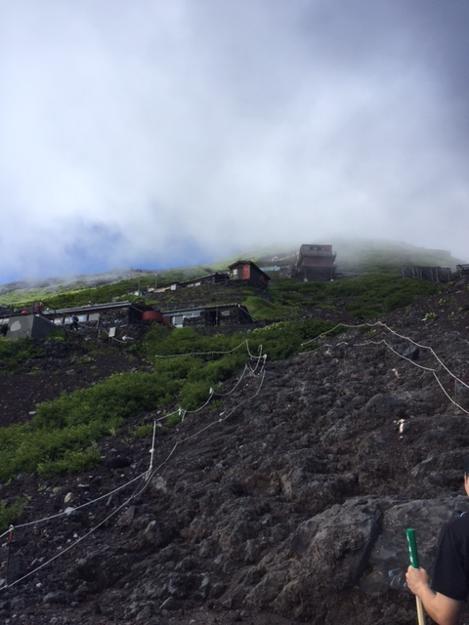
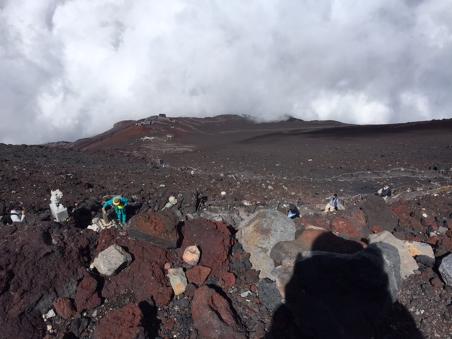
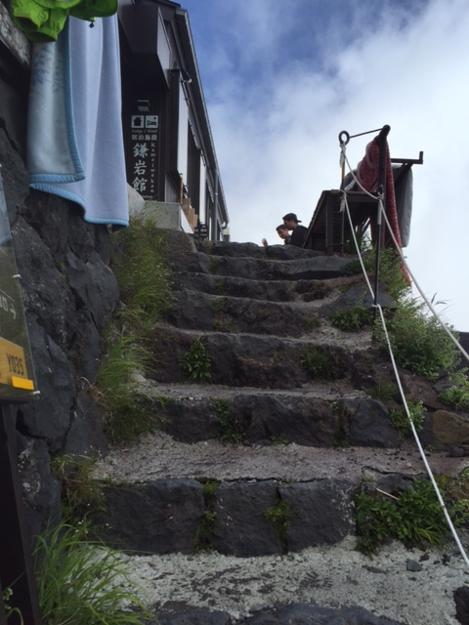
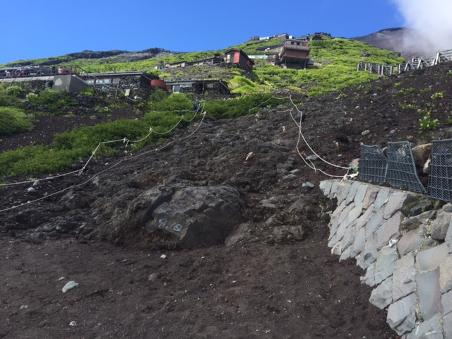
The hike up: This hike was definitely one of the hardest hikes I have ever done, and I have years of backpacking experience having earned my Eagle Scout in a very active backpacking troop in Whittier, California, having hiked a lot in the local Southern California mountains, Sierras, and southern Colorado mountains. The "trail" up the mountain all but disappears halfway up as you quickly learn that you are hiking up an active volcano ... you will be boulder and rock hopping on volcanic rocks, and the 22 degree grade of the Yoshida trail might be an average estimation, but you will hit 70-80 degree points where you are literally pulling yourself up on the volcanic rocks in front of you. When you get above 12,000 feet elevation, you will definitely perceive the relative lack of oxygen ... the last 200 meters took up 45 minutes with few steps and resting to let our lungs recover.
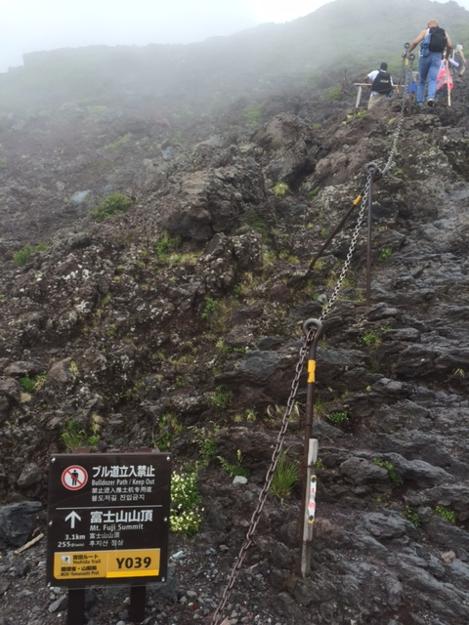
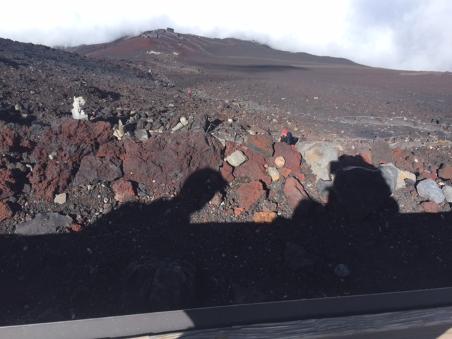
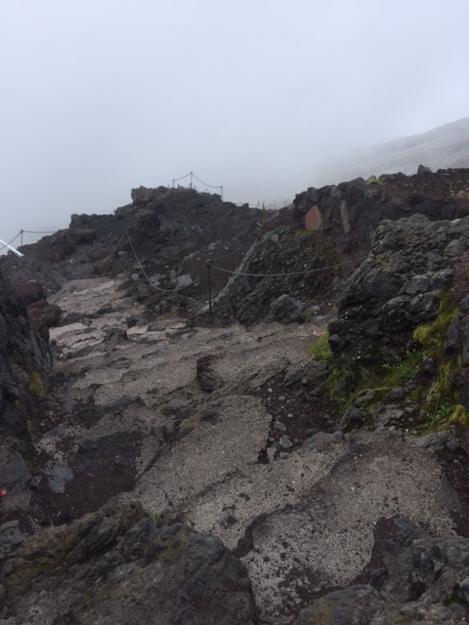
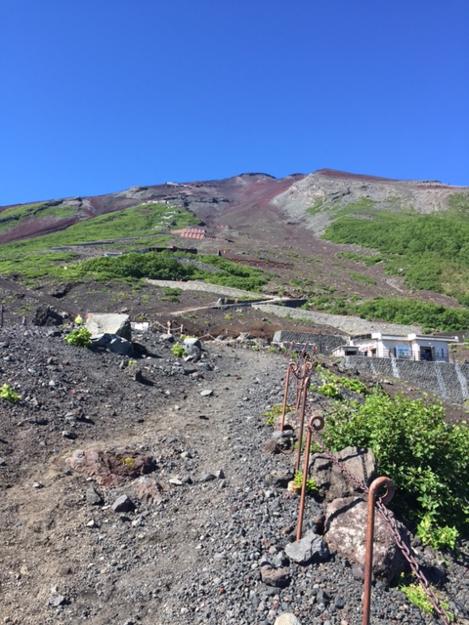
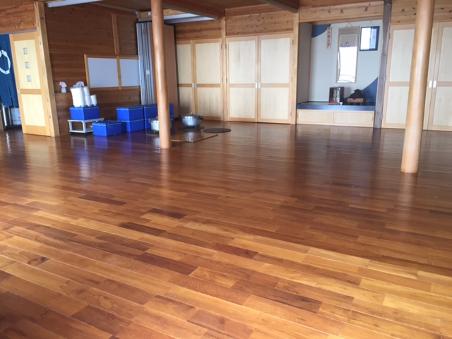
Huts: You will definitely have a more pleasant trip up the mountain if you stay in a hut at some point on your hike (only reliable to do this is make your reservation BEFORE your trip ... see good link below). You can stay at the beginning of your hike at Station 5, or you can stay at Stations 7, 8, or 9 (I don't remember seeing hut at Station 6 on Yoshida Trail). This will let you rest before the arduous hike up, and, more importantly it will let your body accommodate to the altitude and avoid altitude sickness.
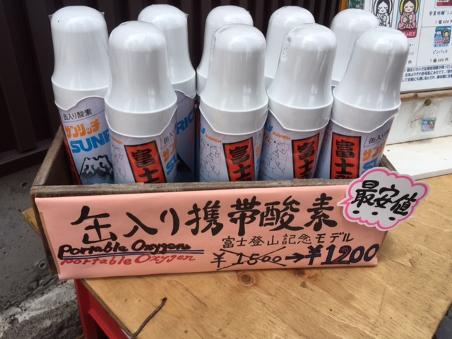
Quick word on Altitude Sickness (since I am a physician): only ONE good treatment for altitude sickness -- DESCEND the mountain. Altitude Sickness occurs due to your body not being able to get enough oxygen at higher altitudes. Commons symptoms are headache (usually throbbing, worse at night and when you wake up), loss of appetite, upset stomach, sometimes vomiting, lack of energy, trouble sleeping, confusion, dizziness, and shortness of breath ... some people say it feels like a hangover. It is impossible to predict who will get altitude sickness -- neither your fitness level nor being male or female has anything to do with whether you will get or not get altitude sickness. Altitude sickness can be dangerous and sometimes fatal -- danger symptoms include confusion, trouble with balance or walking straight, feeling light headed, having blue or gray lips or fingernails, shortness of breath and crackles when you breath (sounds like paper bag being crumpled when you breathe). The best prevention of altitude sickness is to stay at higher altitudes for 1 or more days and let your body accommodate, but you might want to visit your doctor before your trip to obtain a prescription for diamox (acetazolamide) and possibly prednisone, and you can also take motrin (ibuprofen) to help or prevent symptoms. You can bring with you or buy small canisters of oxygen at huts on the way up ... we did not do this, but I am not sure it will help much if you actually develop symptoms. Only ONE treatment: DESCEND ... continuing to the top if you have there symptoms can kill you, and you will not be the first person to die on Mt. Fuji (Google that fact ... there is also shrine to "fallen hikers" near Yoshida Station 1).
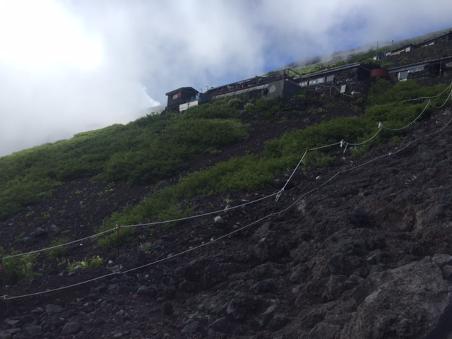
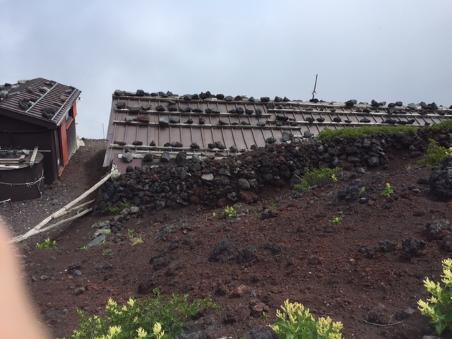
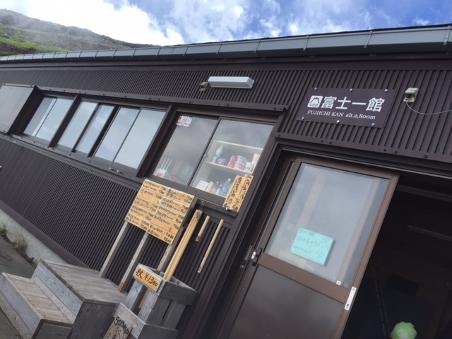
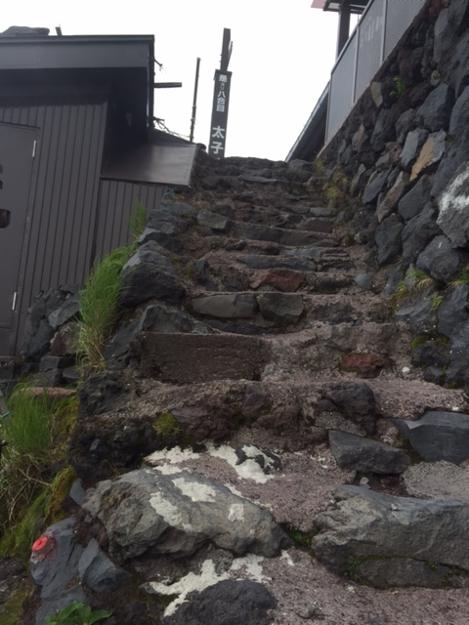
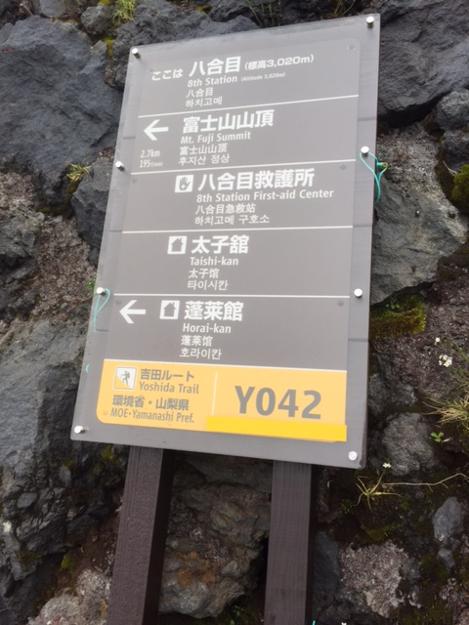
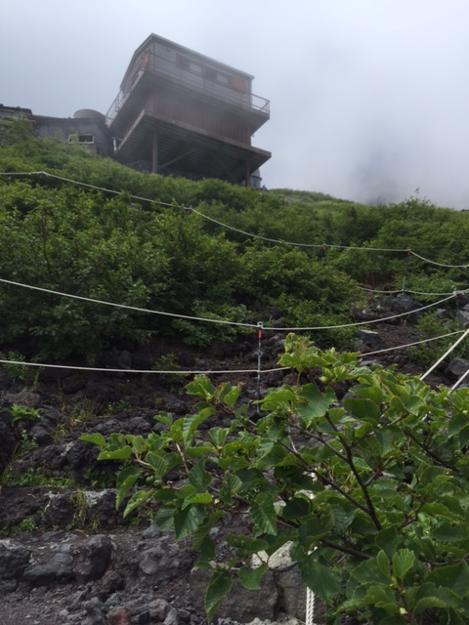
Here are some useful diagrams and web links to make your trip much easier and more enjoyable:
- Japan Guide has a lot of useful information, maps, bus routes, etc.: http://www.japan-guide.com/e/e6901.html
- Official Web Site for Mt. Fuji climbing -- again, great information, weather, emergency, and volcano warnings on top of web site, lots of great links: http://www.fujisan-climb.jp/en
- Japan National Tourist Organization web site, again lots of useful information: http://www.jnto.go.jp/eng/indepth/scenic/mtfuji/fuji_05.html
- Map of Mt. Fuji trails (Yoshida is easiest but busiest trail, Gotemba is hardest steepest and least busy trail): http://www.getoutandtravel.net/wp-content/uploads/2013/12/fuji-yoshidaguchi-trail-hiking-climbing-map.pdf
- Yoshida Trail (main Mt. Fuji trail) great web site: http://www.city.fujiyoshida.yamanashi.jp/div/english/html/climb.html
- Yoshida Trail Huts (remember, you must make reservations BEFORE your trip): http://www.city.fujiyoshida.yamanashi.jp/div/english/html/climbing_huts.html
- Gary Wolff has lots of great information on his web site: http://www.garyjwolff.com/climbing-mt-fuji.html , although I do not believe quote at top of his page (I am definitely going to top of Mt. Fuji again ... next time I want to hike around crater, and I might do Mt. Fuji at night to see sunrise from top): "If you come to Japan and don't climb Mt. Fuji, you're a fool; but if you climb it more than once, you're an even BIGGER fool."
--old Japanese proverb, especially tailored for gaijin-- - See more at: http://www.garyjwolff.com/climbing-mt-fuji.html#sthash.VGdlGhBh.dpuf - Weather on top of Mt. Fuji (6 day forecast): http://www.mountain-forecast.com/peaks/Fuji-san/forecasts/3776
- Live Cameras of Mt. Fuji: http://www.fujisan-climb.jp/en/todays/livecamera.html
- Tokyo train route finder web site (easy to use ... just put in your departs and arrives train station and it will tell you name of train line you need to take ... but of course you need to know name of train stations): http://world.jorudan.co.jp/norikae/cgi-bin/engkeyin.cgi
- BUT much cheaper and more convenient way to get to Kawaguchiko station (last train station right by Lake Kawaguchiko before you have to take another bus or taxi to Yoshida 5th station) is to take the bus from Shinjuko station downtown tokyo (only 1700-2700 Yen) ... you get one bus instead of 4-5 train transfers ... then you take one more bus from Kawaguchiko Station to Mt. Fuji Station 5 (or you hike 2-3 miles or take taxi to Yoshida Station 1 if you decide to hike from there ... here is link to bus schedule: http://www.jnto.go.jp/eng/pdf/transportation/bus_schedule_to_mtfuji.pdf
- Lastly, my next trip to the top of Mt. Fuji will probably start from Station 1 on the Yoshida Trail (gorgeous hike through lush Japan forest), catch nap at Station 5, then leave about 9-10 pm with a lighter pack to get to top of mountain for sun up ... here is a decent personal travel web site about hiking from Sengen Shrine near Yoshida Station 1: http://www.getoutandtravel.net/2014/01/hiking-mt-fuji-part-1-sengen-shrine-to-kawaguchi-5th-station
- And I am definitely including a hike around rim of Mt. Fuji crater which (again, credit to Gary Wolff's great web site) has 8 peaks listed below:
1) Kengamine (剣ヶ峰, elev. 3776m, Japan's highpoint)
2) Hakusandake (白山岳)
3) Kusushidake (久須志岳)
4) Joujugatake (成就岳)
5) Izugatake (伊豆岳)
6) Asahidake (朝日岳)
7) Sengendake (浅間岳)
8) Mishimagatake (三島岳)
